Tell us about the job
Takes about a minute. No obligation.
A heat pump repair in Flathead County starts with the compressor and the reversing valve, because those are the parts carrying the load when the system runs through cold stretches long enough to test a heat pump's capacity limits. Homes in Flathead County, MT run heat about eleven months a year, from August through June. Contractors working a repair here look at refrigerant charge and the reversing valve before chasing electrical faults, because capacity loss in heating mode is often the first symptom that surfaces. The coil contacts and the defrost board also wear earlier than they would in a shorter season, and a technician quoting the job factors that in before settling on a repair scope.
Heat pump repairs in older housing stock tend to surface problems that predate the repair call itself. Half the homes in Flathead County, Montana were built in 1991 or earlier (2020-2024 ACS 5-year). A system running in a house of that vintage has often been adapted more than once, and what a contractor finds when the unit is opened reflects that history: refrigerant lines that have been recharged rather than traced, electrical connections that have worked loose over repeated heating cycles, and compressor wear that a thermostat reading never shows. Parts availability for equipment in stock this old is a real variable, and a contractor working the job has to confirm what the opened system actually takes before a repair scope is set.
The Parts of a Heat Pump a Contractor Checks First
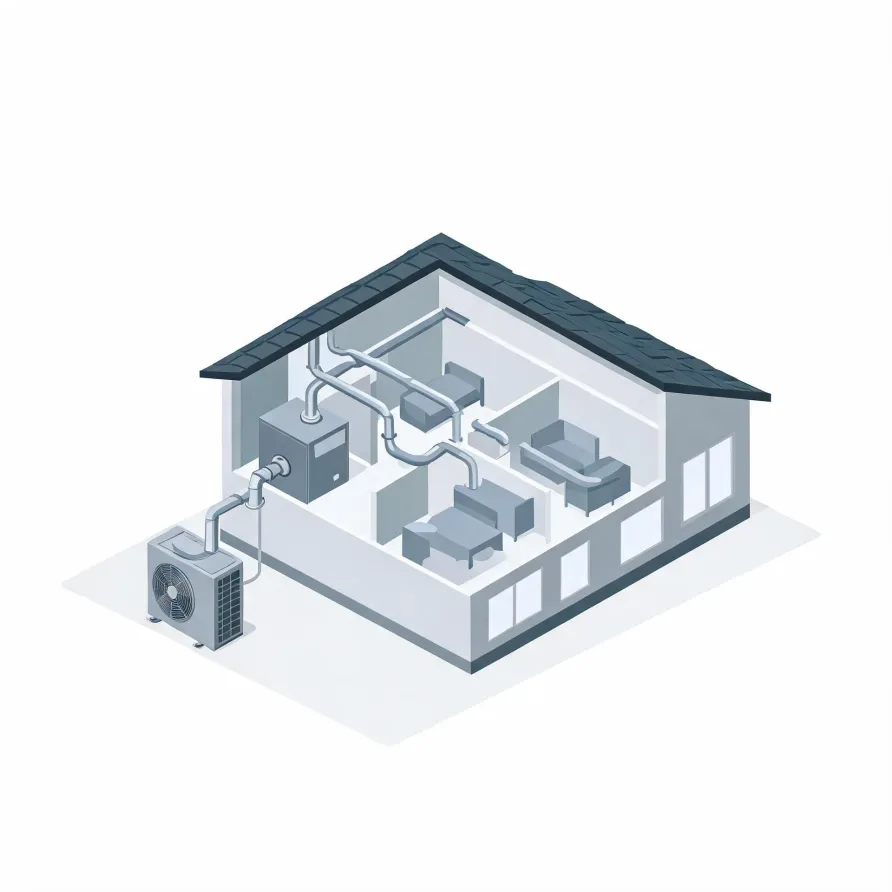
The outdoor unit sits outside the house and holds the compressor and condenser coil. The compressor is where a contractor starts when a heat pump stops moving heat effectively, because a fault there affects everything downstream. The condenser coil and the fan motor that pulls air across it are checked next, since debris, corrosion, or a failed motor each produce their own pattern of symptoms.
Inside the house, the air handler contains the evaporator coil, the blower motor, and the expansion valve, all of which a contractor works through when the outdoor unit checks out but the system still underperforms. The refrigerant lines that run between the two units and the reversing valve, which is what allows the system to shift between heating and cooling, are also on that list.
The drawing shows a typical layout, and a licensed contractor determines which components apply to your specific system and situation.
Find a contractor in Flathead CountyFlathead County, by the record
205 severe weather events were recorded in Flathead County, Montana between 2015 and 2024.
NOAA National Centers for Environmental Information, Storm Events Database, bulk CSV export, events 2015-01-01 through 2024-12-31.Half the homes in Flathead County, Montana were built in 1991 or earlier (2020-2024 ACS 5-year).
U.S. Census Bureau, 2020-2024 American Community Survey 5-Year EstimatesFlathead County, Montana holds 51,680 housing units (2020-2024 ACS 5-year).
U.S. Census Bureau, 2020-2024 American Community Survey 5-Year EstimatesOwners occupy 72.4% of the occupied homes in Flathead County, Montana (2020-2024 ACS 5-year).
U.S. Census Bureau, 2020-2024 American Community Survey 5-Year EstimatesCodes & Standards Governing Heat Pump Repair in Flathead County, Montana2 sourced rules & standards
Licensing Rules for HVAC Repair in Flathead County, Montana
Montana’s contractor licence does not reach a casual, minor or inconsequential job whose total price for labour, materials and everything else is less than $2,500 — and the exemption is lost if the work is only part of a larger operation, or if a job is divided up to get under the figure.
Montana requires a current construction contractor licence from the Department of Labor and Industry: an individual or business may not engage in business as a construction contractor without one.
Severe Weather Events in Flathead County
Flathead County's climate puts real load on heat pump systems, and that load spikes when conditions outside turn harsh. A contractor sizing or repairing equipment here works from the local pattern, not a regional average.
205 severe weather events, 2015–2024. Source: NOAA National Centers for Environmental Information, Storm Events Database.